
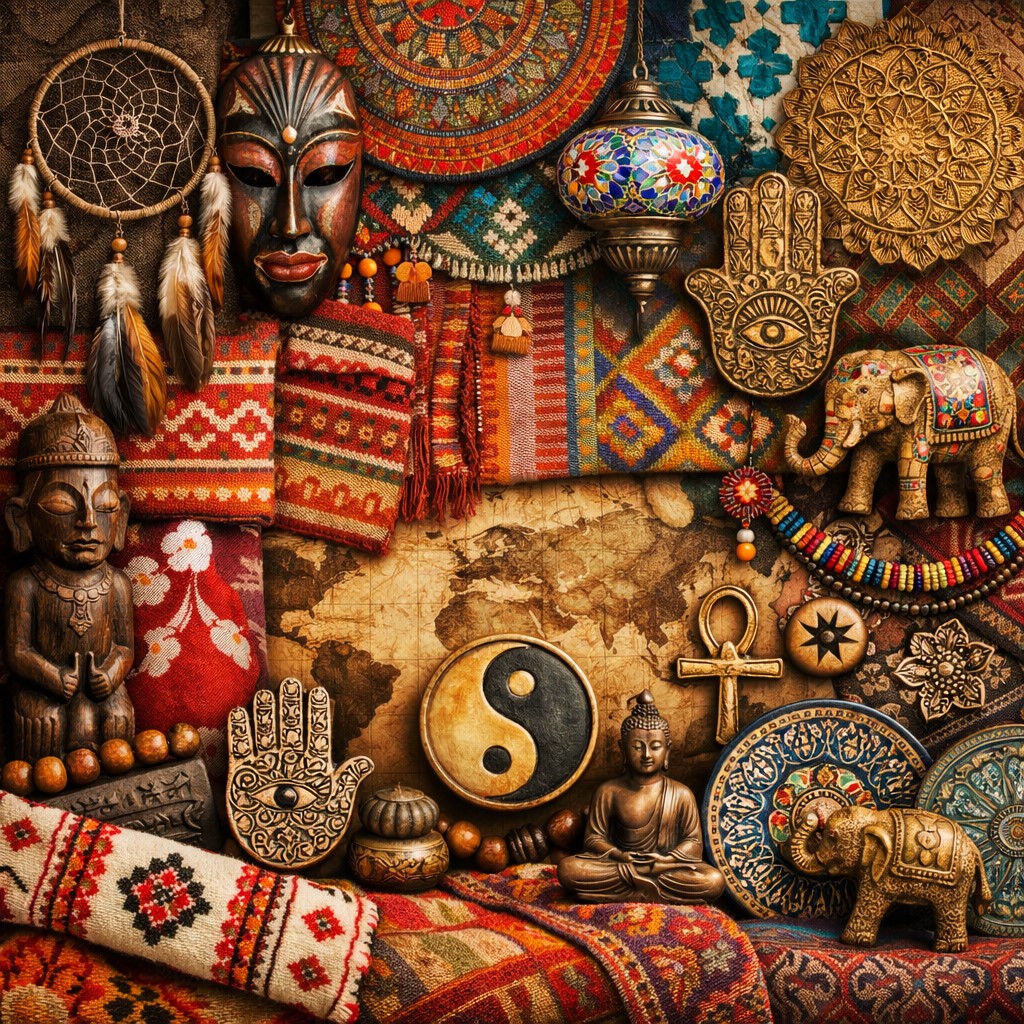
Embracing the Global Tapestry: A Journey Through Ethnic Patterns and Symbols
In our interconnected world, there's something magical about discovering the artistic traditions that have shaped cultures for centuries. I've always been drawn to the way patterns can tell stories without words, how a simple geometric shape can carry the weight of generations, and how colors arranged in specific ways can transport you to places you've never been.
Ethnic designs and patterns aren't just pretty decorations you might see in a museum or on a vacation postcard. They're living pieces of history, each one carrying the dreams, beliefs, and everyday experiences of the people who created them. For anyone working in digital art, running a small business from home, or simply curious about the world's creative heritage, these patterns offer a treasure trove of inspiration that goes far deeper than surface beauty.
What strikes me most about ethnic patterns is their honesty. Unlike modern designs that might change with the season's trends, these traditional motifs have survived because they mean something real to the communities that created them. They speak of harvests and celebrations, of spiritual beliefs and family stories passed down through countless generations.
Designing Across Cultures
African Patterns: Mud Cloth and Bogolan
When I first encountered authentic Mud Cloth from Mali, I was amazed by how something so seemingly simple could feel so profound. The Bogolan tradition, which literally means "mud cloth" in the local Bambara language, represents one of Africa's most sophisticated textile arts. What appears to be a straightforward pattern of lines and shapes on earthy brown fabric actually contains layers of meaning that would take years to fully understand.
The process itself tells a story of resourcefulness and patience. Artisans, traditionally women, hand-spin cotton into cloth, then paint it with fermented mud mixed with leaves and bark. Each symbol has a specific meaning - some represent historical events, others offer protection or convey social status. The zigzag lines might represent the path of a river or the journey of life, while diamond shapes could symbolize the four directions or the cycle of seasons.
For digital artists today, Mud Cloth offers incredible inspiration. I've seen designers create stunning website backgrounds by adapting these geometric patterns, maintaining their structural integrity while translating them into pixels. The key is understanding that each element serves a purpose - you're not just copying shapes, you're working with a visual language that has been refined over centuries.
Home-based entrepreneurs have found success creating modern interpretations of these patterns on everything from throw pillows to phone cases. The earthy color palette works beautifully in contemporary spaces, and there's growing appreciation for handcrafted aesthetics in our increasingly digital world. However, the most successful products I've seen are those where the creators took time to learn about the patterns' origins and could share those stories with their customers.
Middle Eastern Motifs
The mathematical precision of Middle Eastern patterns never fails to leave me in awe. Walking through the Alhambra in Spain or looking at photographs of mosque interiors, you start to understand how geometry can become a form of meditation. These aren't random decorative elements - they're carefully calculated expressions of infinity, unity, and divine order.
Islamic geometric patterns emerged from specific cultural and religious contexts. Since figurative art was often discouraged in religious settings, artists developed incredibly sophisticated abstract designs. These patterns can theoretically extend forever in all directions, symbolizing the infinite nature of creation. The interlocking shapes create a sense of movement and rhythm that draws the eye inward, encouraging contemplation.
What I find particularly fascinating is how these ancient mathematical principles translate perfectly to digital design. Modern software can help us understand the underlying grid systems and rotational symmetries that make these patterns work. Vector graphics programs are particularly well-suited to recreating the clean lines and perfect angles that define Middle Eastern motifs.
For small business owners, Middle Eastern-inspired patterns offer sophisticated design options that work well in luxury markets. I've seen beautiful examples on ceramic tiles, fabric designs, and even laser-cut wooden screens. The key is maintaining the mathematical integrity of the original patterns while adapting them to new materials and applications.
The color palettes traditionally used in Middle Eastern design - deep blues, rich golds, warm terracottas, and crisp whites - translate beautifully to contemporary interiors. These colors evoke feelings of luxury and timelessness that many customers find appealing, especially in a world where fast fashion and disposable design have left people craving something more substantial.
Asian Influences: Symbols and Patterns
Asian design traditions offer perhaps the most diverse range of patterns and symbols, each carrying specific cultural meanings that have evolved over thousands of years. When I think about Japanese design, I'm struck by the principle of finding profound beauty in simple, natural elements. Cherry blossoms aren't just pretty flowers in Japanese art - they represent the fleeting nature of life and the importance of appreciating each moment.
Chinese patterns tend to be more elaborate and symbolic. Dragons represent power and good fortune, but not in the threatening way Western cultures might interpret them. In Chinese tradition, dragons are benevolent creatures associated with water, weather, and imperial power. The way these dragon motifs wind through traditional designs creates dynamic compositions that seem to pulse with energy.
Korean patterns often emphasize harmony and balance, with designs that incorporate elements from both Chinese and Japanese traditions while maintaining their own distinct character. The use of color in Korean traditional patterns is particularly subtle, often employing muted tones that create sophisticated, understated effects.
For digital artists, Asian patterns offer incredible versatility. The range of styles - from the bold, graphic quality of Japanese family crests (kamon) to the flowing, organic lines of Chinese cloud motifs - provides endless creative possibilities. I've seen these patterns adapted successfully for everything from app interfaces to large-scale architectural graphics.
The challenge with Asian-inspired designs is avoiding cliché. It's easy to fall into superficial interpretations that reduce rich cultural traditions to decorative elements. The most successful modern applications I've encountered are those where designers took time to understand the cultural significance of the patterns they were using and found ways to honor that meaning in contemporary contexts.
Creating with Cultural Respect
This brings me to what I consider the most important aspect of working with ethnic patterns - the responsibility that comes with using designs that belong to specific cultural traditions. I've seen too many examples of beautiful patterns being used carelessly, stripped of their meaning and context in ways that feel disrespectful to the cultures that created them.
The concept of cultural appropriation versus appreciation isn't always black and white, but there are some clear guidelines that can help navigate these waters thoughtfully. The difference often lies in approach and intention. Are you trying to learn from and honor a tradition, or are you simply borrowing attractive visual elements without considering their significance?
Research forms the foundation of respectful practice. Before incorporating any ethnic pattern into your work, invest time in understanding its origins. Who created these designs? What do they mean? How are they traditionally used? Are there any sacred or ceremonial aspects that should be respected? This research isn't just about avoiding offense - it often reveals layers of meaning that can make your own work more interesting and authentic.
Building genuine relationships with source communities represents the gold standard for cultural collaboration. I've seen beautiful partnerships between contemporary designers and traditional artisans, where both parties benefit from sharing knowledge and skills. These collaborations often result in more authentic and innovative work than what either party could create alone.
Transparency about sources and inspiration should be standard practice. When you use patterns inspired by specific cultures, acknowledge that inspiration openly. This isn't just about legal protection - it's about giving credit where credit is due and helping educate your audience about the rich traditions you're drawing from.
Understanding the difference between sacred and secular patterns is crucial. Some designs are meant for everyday use, while others have religious or ceremonial significance that requires special respect. What might seem like an attractive pattern to use on a coffee mug could actually be a sacred symbol with deep spiritual meaning.
Launching a Home-Based Business with Ethnic Designs
The growing appreciation for handcrafted, meaningful design has created real opportunities for entrepreneurs who want to work with ethnic-inspired patterns. I've watched several friends build successful home-based businesses in this space, and their experiences have taught me a lot about what works and what doesn't.
Finding your specific focus matters more than trying to cover everything. The most successful businesses I've observed chose a particular cultural tradition or type of product and became experts in that area. Maybe it's African textile patterns applied to modern home decor, or Japanese-inspired stationery design, or Middle Eastern geometric patterns for architectural applications. Having a clear focus helps with everything from product development to marketing.
Leveraging digital tools effectively can level the playing field for small businesses. Design software that might have cost thousands of dollars a decade ago is now accessible to anyone with a computer. Print-on-demand services mean you can offer products without maintaining inventory. Social media platforms provide direct access to customers who appreciate cultural design traditions.
Building authentic marketing stories resonates with customers who want to feel connected to the products they buy. People are increasingly interested in understanding where things come from and what they mean. Customers will often pay premium prices for products that come with authentic cultural stories and educational value.
Starting small and growing gradually seems to work better than trying to launch with a full product line. I've seen entrepreneurs start by offering a few carefully chosen items, learning about their market and customers, then expanding based on what they discover. This approach allows for course corrections and helps build sustainable businesses.
Creating educational content alongside products can differentiate your business from competitors who are simply copying attractive patterns. Blog posts, social media content, or even simple product descriptions that explain the cultural significance of your designs add value for customers and build credibility for your brand.
The Digital Transformation of Traditional Patterns
What excites me most about our current moment is how digital technology is creating new possibilities for preserving and sharing traditional design knowledge. High-resolution scanning can capture textile details that might be lost to time. Digital archives make rare patterns accessible to researchers and artists worldwide. Online marketplaces connect traditional artisans with global customers who appreciate their work.
At the same time, digital tools are enabling new forms of creativity that build on traditional foundations. I've seen artists use parametric design software to explore new variations on ancient geometric principles. Animation brings static patterns to life in ways that reveal their underlying mathematical structures. Virtual and augmented reality technologies offer immersive experiences of traditional architecture and decoration.
The challenge is ensuring that this digital transformation enhances rather than replaces traditional practices. The most exciting projects I've encountered are those that use technology to support traditional artisans, not compete with them. Digital tools can help document traditional techniques, connect artisans with new markets, or enable collaborations between traditional and contemporary artists.
Pattern libraries and design resources need to be developed responsibly, with proper attribution and consideration for the communities that created the original designs. I'm encouraged by organizations that are working to create ethical frameworks for digitizing cultural heritage, ensuring that technology serves to preserve and celebrate traditional arts rather than exploiting them.
Conclusion
Working with ethnic patterns and symbols has taught me that design is never just about making things look attractive. These traditional patterns represent thousands of years of human creativity, problem-solving, and cultural expression. They remind us that art has always been about more than decoration - it's about identity, meaning, and connection.
Whether you're a digital artist looking for fresh inspiration, an entrepreneur seeking to create meaningful products, or simply someone who appreciates beautiful design, ethnic patterns offer riches that go far beyond their visual appeal. They connect us to the full breadth of human creativity and remind us that we're part of a much larger, ongoing conversation about how to make sense of the world through art.
The key is approaching these traditions with curiosity, respect, and genuine appreciation for their depth and significance. When we do that, we don't just create better designs - we participate in keeping these important cultural traditions alive and relevant for future generations. In our globalized world, that feels like both a privilege and a responsibility worth embracing.